You're getting enquiries every week but somehow you're not landing the jobs.
You're three sips into your oat-milk latte when you remember — Sarah, the perfect-fit client who DM'd you eleven days ago asking about your six-month package. You pick up your phone and check. There it is. Read. Unanswered. Embarrassing.
Her DM is buried under 3 freebies you don't remember asking for, and whole load of ManyChat welcome messages.
And the worst thing is you could have helped her. You still want to help her. But you just don’t have a system to make sure you actually followed up.
In this post, I'm going to show you the exact four-part framework I use to make sure that never happens again. Stick with me to Part 4 — that's where the framework stops being a tracker and starts behaving more like a slightly judgmental accountant.
Some straight talking first: If enquiries are landing in your inbox most weeks, you don't have a marketing problem. But you might have a memory problem. And memory, as it turns out, is a deeply unreliable employee - it takes random days off, gets overwhelmed on busy days, but you can't fire it.
Forgetting to follow up will keep you broke. Not tightening your belt broke. PROPERLY broke. The kind where you start Googling whether your pet budgie counts as a dependent.
The good news? A boring little framework is often the only thing standing between "another month of hoping" and a calendar that pretty much books itself.
Here's the four-part framework. You can start putting into practice today.
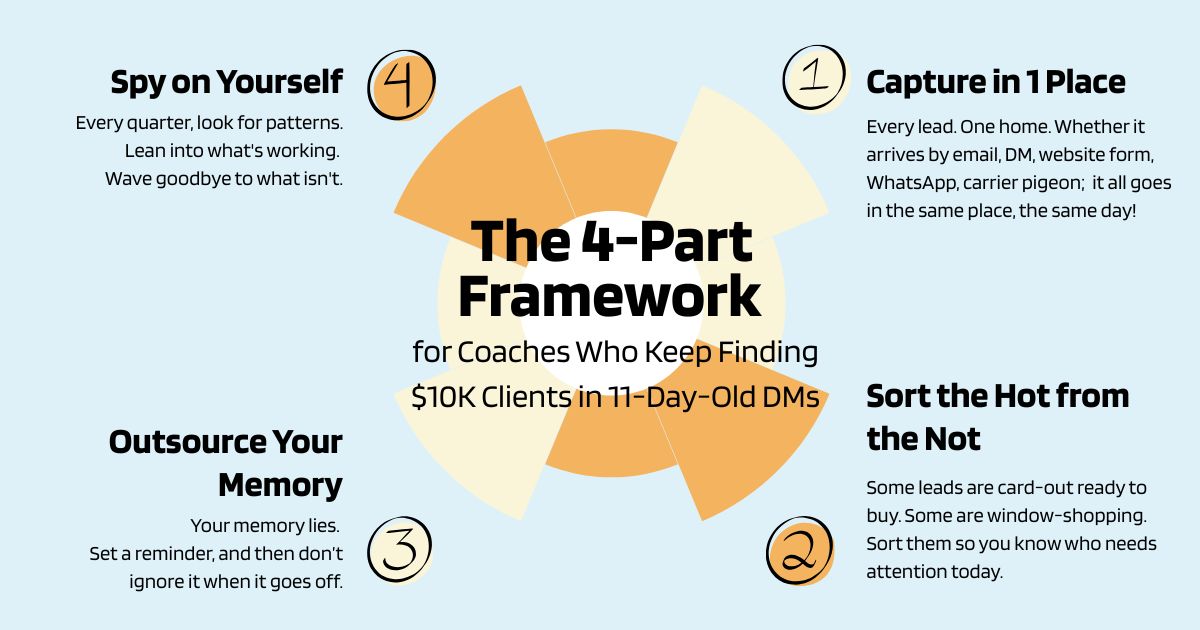
Part 1: Start Using One Place. Just One. I Mean It.
Right now, your leads are living in twelve different houses. There's the one who emailed. The one who DM'd you on Instagram at 11pm with a 500-word life story. The one who messaged on Facebook (yes, people still do that). The LinkedIn "quick question" that wasn't quick. The text from a friend-of-a-friend. The contact form that came in while you were at yoga class. The voice note. The one who cornered you at a wedding.
The moment they live in twelve different places, they start ghosting you — except actually you're ghosting them, you just haven't realised yet.
Choose one place. Just one. It could be a simple Google Sheet, HubSpot, Asana, pen and paper - if you like to go analogue. Or - shameless plug incoming - a voice-first lead tracker built for solopreneurs who remember leads while walking the dog or waiting for coffee ;)
The tool doesn’t matter nearly as much as just choosing and sticking to one place.
Someone emails you? In the tracker. Someone slides into your DMs? In the tracker. Someone fills out your contact form? In the tracker. Someone mentions in passing at a school pickup that they've "been meaning to ask about coaching"? In the tracker, before they even finish their sentence.
You’re creating one source of truth. One place where you can look and instantly see every person who’s interested in what you do.
(Quick note: Don't dump your entire mailing list into your lead tracker. We're hunting for people who've shown actual buying intent - not browsers who only wanted your free PDF. Your mailing list gets nurtured every time you email it. You ARE emailing it, right? Right??)
Part 2: Sort Your Leads Like You Sort Your Dirty Washing (Some Are Ready to Wash Now. Some Need Soaking.)
Treating every lead the same is how you end up sending a "just checking in!" email to someone who was ready to swipe their card three days ago.
Some leads are ready NOW. They're sat with their card on the desk waiting for you to send the link. Others are doing the comparison-shop thing — you, 3 other coaches, and a Skool community their mate mentioned. Some are window-shopping with no intention of buying. And some are perfectly lovely humans who will never, ever, in a thousand years, become your client. The trick is knowing which is which before you spend three weeks chasing a window-shopper around the internet.
Create separate stages for each level of the buying journey:
- New Lead - Brand new. Pristine. You haven't even had a Zoom with them yet.
- Qualified - You've talked. They're a good fit.
- Active Conversation - Back-and-forth is happening. Voice notes are flying. Calendar links are being exchanged.
- Ready to Close - Basically saying yes. They just need the paperwork.
- Closed / Not a Fit - Either they signed, or it gracefully fizzled. Either is fine.
The moment you add a lead, ask yourself: where does this person actually belong? Have they told me they’re ready to buy? Have I talked to them yet? Are they actually right for what I do?
Categorise like this and your priorities sort themselves. The Ready-to-Close folks get treated like the last train home — you do not miss them. Active Conversations get warmth and quick replies. Window-shoppers get a polite nudge and not a single minute more of your busy week.
Part 3: Outsource Your Memory To a Calendar (Because Your Memory Lies)
Following up is where most people fail.
Set the calendar reminder. Set it the moment you add the lead. Set it before you do anything else. Because here's what happens if you don't: life happens. The dog needs walking. Your client portal goes down at the worst possible time. It's your nephew's birthday and you have to organise the cake. And somewhere in the chaos, the woman who was 90% ready to give you $10,000 quietly hires someone else who got back to her quickly.
So, as soon as you add a lead and categorise them, set a reminder for when you’re going to follow up.
New lead and you haven’t qualified them yet? Do it today, or set a reminder for tomorrow. You want to follow up fast.
Active Conversation? Three days. Any longer and they start to cool off like an abandoned cuppa.
Ready to Close? Tomorrow. Today, if you haven't heard back and were expecting a reply.
Never rely on memory. Let your calendar do the work.
When the reminder pops up don't just open your email and type "just checking in!" like a dullard. (We've all been the dullard. It's fine. We forgive you.) You open your tracker. You see where this person is. You see what you last talked about — her business, her launch, her dog's separation anxiety, whatever it was. And you write to her like a human who actually remembered.
Part 4: Spy On Yourself
This is what separates people who try systems from people who absolutely nail them. It's also where the framework stops being a tracker and starts behaving like that somewhat judgmental accountant I promised you at the start.
Log every single interaction. You had a discovery call? Log it. Sent a proposal? Log it. They said no? Log it. They said yes? Log it. They said "maybe in Q3"? Log that too — Q3 will get here.
Why? Because at the end of every month or quarter, you’re going to look at your data and be able to see patterns.
You might notice that leads from your podcast convert twice as fast as leads from Instagram. You might notice that when you book a discovery call within 24 hours of first contact, your close rate jumps 40 percent. You might realise that anyone who books at 11pm on a Sunday is an absolute joy to work with — and anyone who replies "sounds expensive" to your pricing page never, ever converts. Not once.
These insights are the closest thing to a cheat code your business will ever get. They tell you where to lean in, where to back off, who to chase, and get more selective about who you even add to your tracker in the first place.
The businesses that scale quickly don’t just follow a system; they improve it constantly based on real data from the conversations they're having.
The Hard Part When It Comes to Implementing a Follow Up System
So let me recap: One place. Sort them. Set reminders. Track what happens.
That’s it. That’s the framework.
And honestly, most people won't do this. Not because it's hard — it isn't. But because it feels suspiciously like admin, and admin doesn't release dopamine the way refreshing your DMs does. So they keep their leads scattered across 7 different apps and quietly hope. Hope is a beautiful thing. But it's also a TERRIBLE follow-up strategy.
But you’re not most people. You know there’s a better way.
So here's what you do right now — yes, now, before you flick away to another tab: pick one tracker. Just one. It doesn't have to be perfect. It doesn't have to be expensive. It doesn't have to be the one you'll use forever. It just has to be the one you'll use today. Create the stages. Set the reminders. Log your first interaction. Done.
Do that, and you'll never lose a hot lead again.
And if you want a tracker that works when you're on the go, try WalkTalk! It's the lead tracker for coaches that captures leads using your voice - so the system works while you're walking the dog, queuing for coffee, or hiding from a toddler in the airing cupboard. When you take away the friction of sitting down at your desk to type in your updates, it's amazing how easy it can be.